
Aloe Vera: A Care Guide
Aloe vera is one of the few houseplants people buy for a reason other than how it looks. It's been carried around the world and grown in kitchens for centuries,...



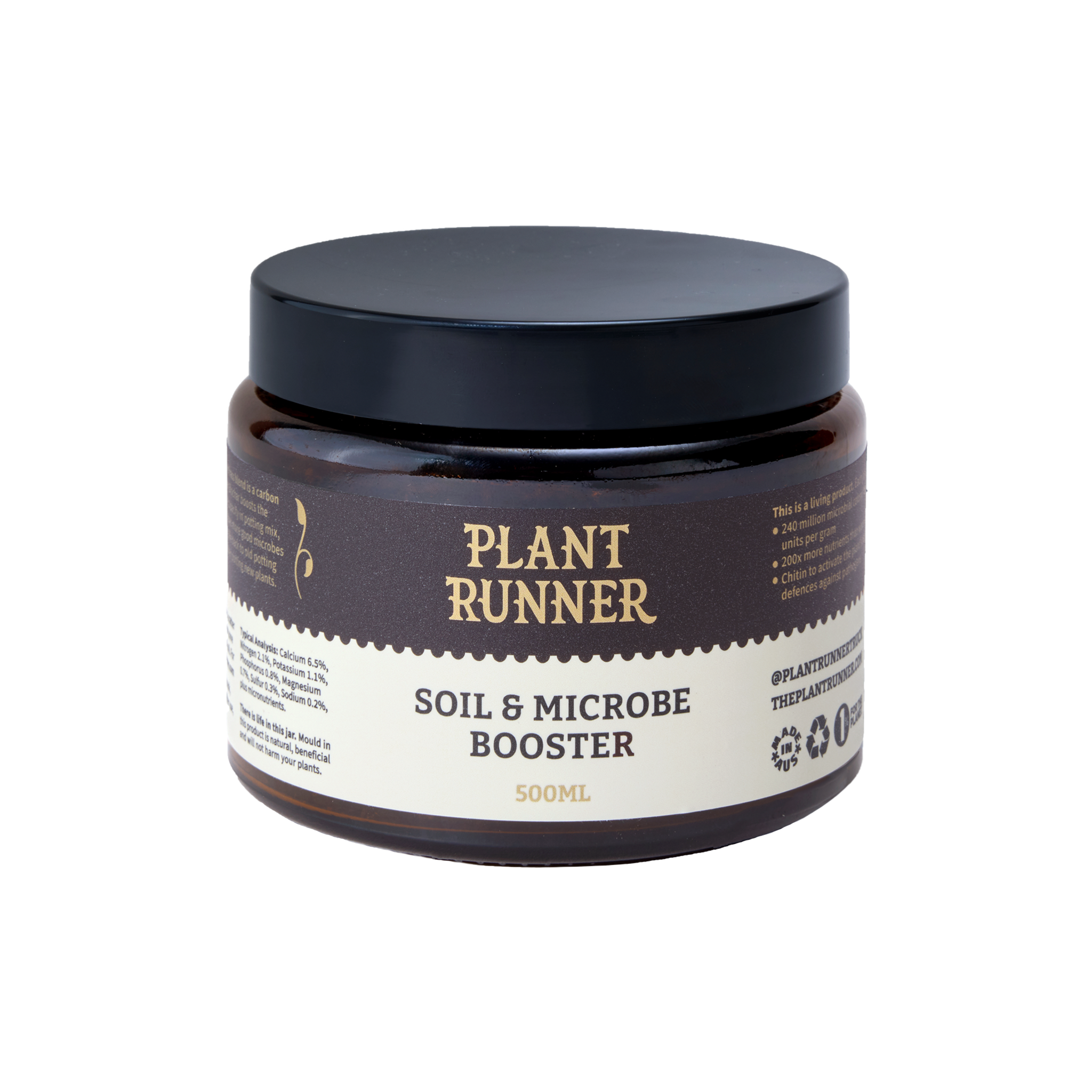


Outdoors, soil is alive. Fungi, bacteria, worms and insects turn dead material into something roots can use, and they've been doing it without any help for a very long time. A pot has none of that. Fresh potting mix is mostly bark and coir, and nothing moves in on its own.
Frass carries a living microbial community into the mix, along with the organic matter those microbes feed on. As they break it down they release nutrients the roots can take up — slowly, over weeks, not all at once. The biochar keeps it there: a porous charcoal that holds water and nutrients in the root zone instead of letting them wash through, and gives the microbes somewhere to live. Nitrogen 2.1%, phosphorus 0.8%, potassium 1.1%, plus iron, copper, zinc and manganese in trace amounts. Deliberately mild. It's not here to replace your plant food; it's here to make the mix better at holding and delivering what you give it.
It also carries chitin, from the insect exoskeletons — the reason frass gets talked about beyond its nutrients. We've written that up in what is frass?
One thing to know: it's organic matter, and organic matter in a pot that's kept wet is what fungus gnats are looking for. Let the mix dry back properly between waterings and they don't get a foothold. If you've got them already, here's what to do.
This is the Mix step of the Plant Runner Method: get the roots' environment right before you reach for feed. A by-product, not a product — frass is what's left after insects are farmed on food waste; nothing is grown, mined or manufactured to make it. Australian frass, Australian biochar, blended in Melbourne. 500ml jar or 3L pouch, year round.
Pairs with Aroid Mix and Indoor Potting Mix: stir it through at repotting and the mix starts out with the life it would otherwise take months to acquire.
How much to use
|
Use |
How |
Rate |
|
Indoor pots — repotting |
Stir through fresh mix |
5% by volume (1 in 20) — about a heaped tablespoon per litre of mix. Up to 10% for tired mix or large planters. |
|
Indoor pots — between repots |
Scrape back the top 2cm, work in, water in |
1 tablespoon per 15cm of pot diameter, once or twice a year |
|
Garden beds and new plantings |
Work into the top 10cm, or mix through the backfill |
1–1.5L per m², or 5% of backfill volume. Up to 10% in poor sandy soil. |
|
Trees |
Rake into the surface under the canopy |
1–5L per m² — the higher end for newly planted trees |
|
Compost |
Mix through the heap |
5% by volume |
|
Seedlings and cuttings |
Mix through the raising mix |
5%, no more |
Use year round. Water in after applying. Keep the lid on between uses — it's a living product and does best kept dry and out of the sun.





Biochar is a horticultural char-like substance, created by heating biomass in low oxygen conditions. It is used to improve soil health, increase water retention and sequester carbon.
Chitin makes up one of the components of the exoskeletons of arthropods. As the black soldier flies that produce our frass grow, they shed their exoskeletons and it becomes a part of the mix. Research has shown that chitin enhances plant health and disease resistance. It can work like a natural defence agent - inhibiting fungal and bacterial pathogens, as well as improving soil quality and encouraging plant growth.
Frass is the term used to describe the excrement of insects. The frass found in our Soil & Microbe Booster comes from the black soldier fly. It is a natural fertiliser and high in beneficial microbes as well as being rich in nitrogen, phosphorus and potassium.
No, not at all. Put simply, this is a living product and the ‘mould’ is a saprophytic fungi growing on the decaying organic matter. It speeds up the breakdown of organic matter and releases nutrients into the soil. It will not harm your plant, and can be stirred through the potting mix or even compost. Always wear gloves and use a mask when handling the product.
If your plants are being treated with a systemic pesticide, you should wait at least one month after the final treatment before adding the Soil & Microbe Booster to your potting mix.
The Soil & Microbe Booster makes an excellent addition to the Plant Runner range of potting mixes. It can be blended in at the time of repotting, or simply added to the top of existing potted plants.
Frass generally has a much higher diversity of beneficial bacteria and fungi compared to worm castings, leading to a broader range of benefits for the soil and the plant. Frass also contains chitin, which is a natural defence agent for plants.
The good news is this isusually a normal side-effect of using our Soil & Microbe Booster. It’s a living microbial product (beneficial bacteria + fungi) designed to repopulate tired potting mix and support healthier nutrient cycling in the root zone. When those microbes get into a warm, moist mix, you can sometimes see a fluffy white saprophytic fungus pop up on the surface — it’s feeding on organic matter in the mix, not the plant.
The easiest way to fix this:
Featured Post
When it comes to nurturing healthy houseplants, the soil is as important as the plant itself. Hidden within the soil is an intricate ecosystem teeming with life, including billions of tiny microorganisms that play a key role in maintaining soil health. But what exactly are these soil microbes, and why are they so vital to your plants' well-being?
Featured Post
You would be forgiven if you hadn't heard of Frass before, and kudos to you for even clicking through to read about it. But you'll be glad you did because this stuff is an absolute game changer.
Aloe vera is one of the few houseplants people buy for a reason other than how it looks. It's been carried around the world and grown in kitchens for centuries,...

Spring is the window, not the reason. A horticulturalist's guide to reading the root zone before you reach for a bigger pot.

The mini monstera is one of the most mislabelled plants on the bench. You'll see it sold as Monstera Ginny, Philodendron Ginny, Philodendron Minima and mini monstera. The first three...

By the time the calendar catches up, most of your plants are already weeks into their restart — quietly, while the heater's still running and you're still wearing the big...

There's a quiet assumption in plant care that the answer to almost everything is a bigger pot and a fresh bag of mix. Plant looking tired? Repot it. Growth stalled?...

A big plant changes a room in a way a small one can't. Done well, it makes a room feel finished. Done badly, it slowly browns in the corner while everyone...

Chinese Evergreen is the plant that genuinely earns the low-light label — with a qualification. The dark-leaved, less variegated varieties are among the most light-tolerant indoor plants you can keep....

The short answer is yes, sometimes — and no, not in the way you're probably worried about.